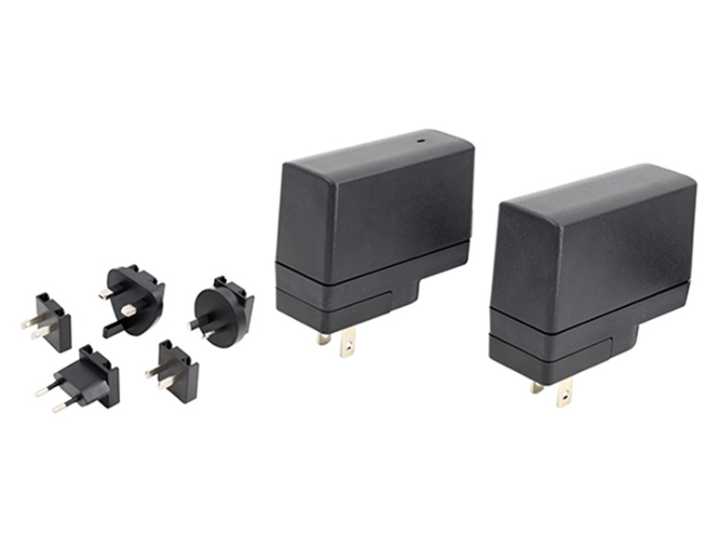
Portable ventilators place specific demands on external power because they may need to operate during patient transport, temporary care, emergency preparation, or movement between medical areas. Unlike ordinary portable electronics, a ventilator may combine a motor, sensors, control circuits, displays, alarms, and a rechargeable battery. This makes the external power source part of the overall system design. A universal AC charger adapter can be considered when manufacturers need external AC-DC conversion together with battery charging capability, but the right choice depends on the ventilator’s electrical, safety, and mobility requirements.
For OEMs and medical equipment integrators, comparing adapters by output voltage alone is not enough. The following five selection options focus on the technical characteristics that can influence portable ventilator development.
- Match the Adapter With the Ventilator’s Power Architecture
The first consideration is whether the adapter can provide the electrical characteristics required by the ventilator. Engineers should check rated output voltage, current, total power, input range, connector configuration, and the relationship between external power and the internal battery system.
A portable ventilator may operate directly from an external supply when connected to an outlet while using its battery when external power is unavailable. The adapter therefore needs to work correctly with the equipment’s power-path and charging architecture.
For low-power ventilator systems, an adapter with several output configurations may provide useful flexibility during product development. However, the selected output must always correspond to the actual charging and operating requirements established by the equipment manufacturer.
- Prioritize Medical Electrical Safety
Portable ventilators are used in medical environments, so electrical safety deserves specific attention. The adapter should be evaluated according to the safety requirements applicable to the final equipment and its intended use.
Important factors include isolation, leakage current, insulation structure, creepage and clearance distances, and protection against abnormal electrical conditions. These characteristics become especially relevant when the power system is connected to equipment used near patients.
The UES12LCP-SPA/UES12LCP-SPC series provides 2 MOPP isolation protection and supports BF-level medical device applications. It also incorporates short-circuit, overvoltage, and overload protection.
These features can provide useful reference points when comparing external power options. Nevertheless, the final safety performance must be evaluated at system level because the enclosure, cable, connector, grounding, and internal circuits can also influence compliance.
- Consider Battery Charging Requirements
Many portable ventilators use rechargeable batteries to maintain operation when external AC power is unavailable. This means the adapter may need to supply both operating power and energy for battery charging.
Engineers should determine whether the equipment uses a separate charging controller or expects charging-related functions from the external power source. Current control, output stability, and compatibility with the battery management architecture should be reviewed before selection.
The UES12LCP-SPA/UES12LCP-SPC series supports constant-current and conversion functions for suitable charging applications. It provides 4V to 24V output options and up to 12W of power.
For a ventilator manufacturer, these specifications can be useful when evaluating compact battery-powered equipment. The important point is to confirm that the adapter’s capabilities match the complete charging system rather than assuming that any DC output can charge the battery directly.
- Evaluate EMC and Continuous Operation
Portable ventilators contain electronic control systems and may operate alongside patient monitors, communication equipment, and other medical electronics. Electromagnetic compatibility therefore needs to be considered during power selection.
Switching converters can generate high-frequency noise. Filtering, grounding, cable routing, PCB layout, and the physical relationship between the adapter and equipment can affect the final EMC result.
Manufacturers should ideally evaluate the adapter together with the actual ventilator prototype. This allows engineers to identify whether the power system introduces interference into sensors, displays, alarms, communication modules, or control circuits.
Continuous operation is another consideration. Engineers should review thermal performance and operating conditions rather than selecting an adapter based only on its nominal output. If the equipment operates for long periods, the power system should be evaluated under representative load and environmental conditions.
- Look at Regional and Environmental Compatibility
Portable medical equipment may be sold internationally, making AC plug compatibility an important practical consideration. Different countries use different outlet configurations, so a fixed plug design may require additional product versions.
Interchangeable AC pin configurations can provide greater flexibility for international equipment programs. This can simplify product configuration when the same ventilator platform is prepared for different markets.
Environmental conditions should also be included in the evaluation. Portable equipment may be used at different altitudes and temperatures depending on its destination and application.
The UES12LCP-SPA/UES12LCP-SPC series supports interchangeable AC pin styles and a working altitude of up to 5000 meters. It also specifies DOE Level VI efficiency and CoC V5 Tier 2 (2016) requirements, with standby power consumption of ≤0.075W.
These specifications do not automatically make an adapter suitable for every ventilator. Instead, they provide technical points for engineers to compare against their equipment’s operating conditions.
How OEMs Can Compare Different Adapter Options
When comparing external power options, medical equipment manufacturers can create a technical checklist covering five areas: electrical compatibility, medical safety, charging behavior, EMC performance, and environmental adaptability.
The mechanical interface should also be reviewed. Connector type, cable length, adapter dimensions, and handling requirements can influence how easily the power solution fits into a portable ventilator system.
For OEM projects, verification should begin during the prototype stage. Testing the adapter with the actual ventilator can reveal issues that may not appear during standalone component evaluation. This approach can also help identify issues related to voltage stability, connector compatibility, and thermal performance before certification and mass production, reducing the need for design adjustments at later stages.
UE Electronic provides external power solutions for medical, communication, and industrial applications. Its product development experience can support manufacturers evaluating power configurations for different equipment structures and application conditions.
Making a Practical Choice for Portable Ventilator Projects
There is no single external adapter that suits every portable ventilator because equipment architectures, battery systems, power levels, and regulatory requirements differ. The better approach is to compare available options against the complete application.
A universal AC charger adapter may be suitable when a project requires compact AC-DC conversion, battery charging support, flexible AC plug configurations, and medical safety considerations. Before approval, OEMs should verify output compatibility, charging behavior, isolation, protection functions, EMC performance, thermal conditions, and regional requirements.
For portable ventilator manufacturers, power selection should therefore happen early in the product development process. Evaluating these factors together can help engineers choose a practical external power architecture and reduce compatibility issues during later system integration.
