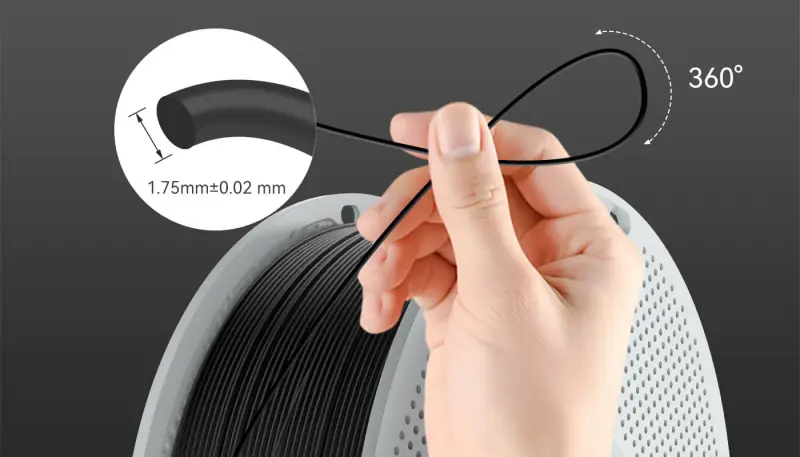
Printing with carbon fiber filament requires attention to material characteristics and filament consistency. SUNLU PA12 Carbon Fiber (PA12-CF) is designed for high-precision engineering components, offering lower moisture absorption and superior dimensional stability compared with PA6. Its 1.75±0.02mm diameter is also tightly controlled, supporting consistent extrusion, equipment compatibility, and reliable printing performance.
Understand the Characteristics of PA12-CF
Material selection is the first consideration when working with carbon fiber-reinforced filament. SUNLU PA12-CF offers lower moisture absorption than PA6, which helps make it suitable for applications requiring greater dimensional stability. For printing, the recommended nozzle temperature and print speed are 260–280℃ and 60–100mm/s, while the recommended bed temperature is 60–70℃.
For businesses producing engineering components, dimensional stability can be especially important. Parts that need to maintain their intended dimensions require a filament with characteristics suited to precision-oriented printing. PA12-CF is positioned for this type of application, combining the characteristics of PA12 with carbon fiber reinforcement. Its heat deflection temperature is 175±3℃, providing a clear reference for evaluating its suitability for engineering applications.
The material is therefore suitable for printing high-precision engineering components. Rather than treating carbon fiber filament as a general-purpose material, professional users can consider PA12-CF when dimensional stability and engineering applications are important. Following the recommended 260–280℃ nozzle temperature, 60–100mm/s print speed, and 60–70℃ bed temperature can also help users apply the material according to its specified printing parameters.
Check the Filament Diameter Before Printing
Filament diameter directly affects extrusion consistency. SUNLU PA12-CF is strictly controlled within a 1.75±0.02mm diameter tolerance range, providing consistent and uniform filament quality.
For FDM printing, this precise diameter supports smooth extrusion through the nozzle. Consistent filament dimensions help reduce potential issues associated with irregular feeding and extrusion, making diameter control an important consideration when preparing a production workflow.
The 1.75±0.02mm specification also provides high equipment compatibility. For businesses using various FDM printers, maintaining a precise filament diameter can help support stable performance across different equipment and printing tasks.
Why 1.75 mm Carbon Fiber Filament Matters
The value of 1.75 mm carbon fiber filament is not simply its nominal diameter. The tolerance is equally important. SUNLU PA12-CF maintains a diameter of 1.75±0.02mm, which represents tight control over filament dimensions.
This precision allows the filament to pass smoothly through the nozzle. More uniform feeding can support stable extrusion and help reduce clogging and filament breakage. These characteristics are particularly relevant when consistent output is required across repeated engineering printing jobs.
A tightly controlled filament diameter can also contribute to dimensional accuracy and surface finish. When filament quality remains consistent, the extrusion process can operate more uniformly, supporting more predictable results from one print to another.
Use Consistent Filament for Reliable Extrusion
A reliable printing process begins with consistent consumables. With SUNLU PA12-CF, the controlled 1.75±0.02mm diameter is intended to provide uniform filament quality throughout the material.
For production users, this consistency can simplify the printing process. Instead of dealing with significant diameter variation, users can work with filament that is precisely controlled within the specified tolerance range.
Stable extrusion is particularly useful when printing engineering components. Smooth filament movement through the nozzle can help reduce clogging and filament breakage, while consistent extrusion contributes to the dimensional accuracy and surface finish of printed parts.
Match PA12-CF to Precision Applications
Not every carbon fiber printing project has the same requirements. PA12-CF is specifically suitable for high-precision engineering components because of its lower moisture absorption and superior dimensional stability compared with PA6.
This makes the material relevant to businesses where dimensional performance is an important consideration. The material choice should therefore reflect the intended application rather than simply selecting carbon fiber filament because of its reinforcement.
When the goal is to produce engineering components requiring stable dimensions, PA12-CF provides a material option designed around these requirements. Its combination of material characteristics and controlled filament diameter supports a more reliable approach to precision FDM printing.
Tips for a More Reliable Printing Workflow
A practical workflow should begin with confirming that the printer is compatible with the filament’s 1.75mm format. SUNLU PA12-CF’s 1.75±0.02mm diameter provides high compatibility with FDM equipment and different printing tasks.
Next, maintaining consistent filament feeding should remain a priority. The precise diameter helps the filament move smoothly through the nozzle, reducing the risk of clogging and filament breakage.
Finally, users should consider the intended application when evaluating the printed result. PA12-CF is designed for high-precision engineering components, while its lower moisture absorption and superior dimensional stability compared with PA6 make it appropriate for precision-oriented applications.
Improve Results Through Material and Filament Control
Successful carbon fiber printing depends on more than the presence of carbon fiber reinforcement. Material characteristics and filament consistency both influence the printing process. SUNLU PA12-CF combines lower moisture absorption and superior dimensional stability compared with PA6 with a tightly controlled 1.75±0.02mm filament diameter.
For professional users, this combination provides a practical foundation for producing high-precision engineering components. The precise diameter supports smooth extrusion, reduces clogging and filament breakage, and can improve dimensional accuracy and surface finish.
By selecting PA12-CF for suitable engineering applications and paying close attention to filament consistency, businesses can establish a more stable FDM printing workflow. For applications requiring 1.75 mm carbon fiber filament, SUNLU PA12-CF provides a precisely controlled material option designed for reliable and efficient printing performance.
