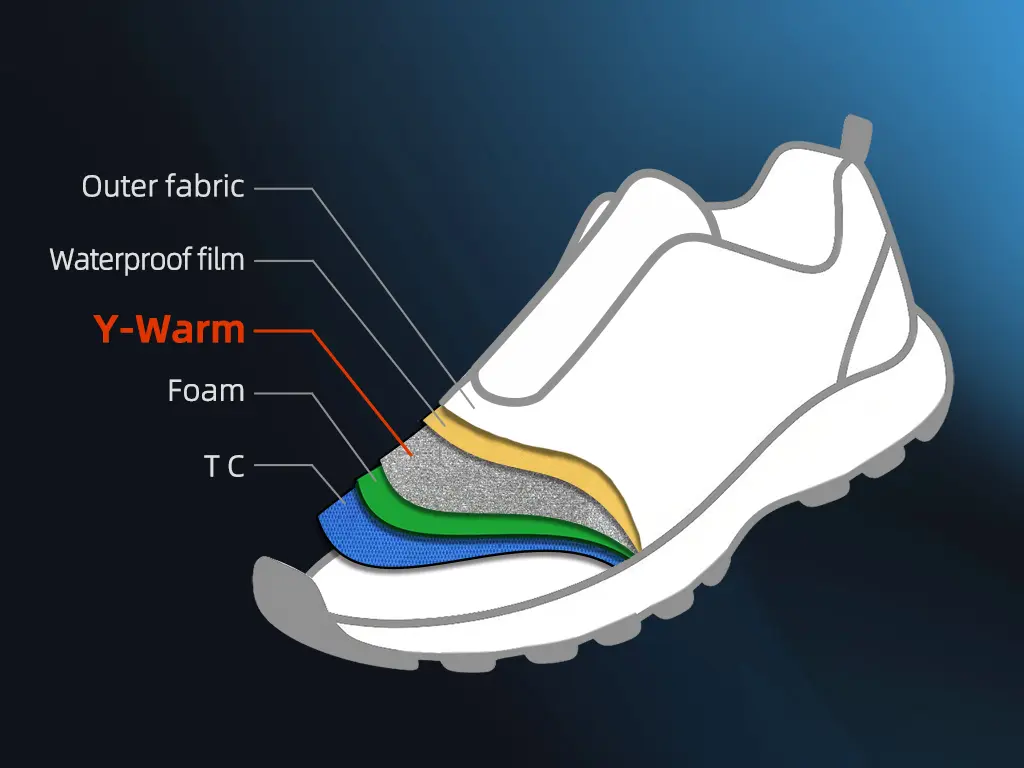
Designing winter footwear involves more than choosing a material with good thermal resistance. An effective insulation layer must work within a moving, compressing structure while preserving underfoot comfort, fit, and long-term performance. For footwear brands and product developers, the challenge is to achieve sufficient warmth without making shoes unnecessarily thick or rigid. This is where material flexibility and recovery after repeated deformation become important considerations.
Why Insulation for Shoes Must Handle Repeated Flexing
Footwear insulation experiences a very different mechanical environment from insulation used in relatively static products. Every step can involve bending, compression, and deformation around the forefoot and sole. Over thousands of walking cycles, the insulation layer must remain compatible with the surrounding construction rather than becoming an obstacle to natural movement.
Underfoot comfort is also closely connected with the footwear microclimate. Research on insole materials has shown that heat and moisture management can influence thermal comfort, with breathable and porous structures helping regulate the conditions around the foot.
Traditional bulky insulation can provide useful thermal resistance, but adding thickness may consume valuable internal space and affect the way a shoe fits or flexes. This creates a product-development trade-off: more material can support insulation, but excessive bulk may work against lightweight construction and mobility.
How Material Recovery Supports Footwear Performance
Flexibility and recovery should be considered separately. A material may bend easily but fail to recover its original structure effectively after repeated deformation. Conversely, a highly resilient material may provide recovery but feel too stiff when integrated into a shoe.
Y-Warm is a flexible thermal insulation material with micrometer-scale closed cells and nanometer-scale cell walls. Its technical information states that it has limited stretch in both warp and weft directions but offers good recovery after folding or deformation. Where additional flexibility is required, bias cutting can provide greater stretch than straight-grain cutting.
For footwear manufacturers, this characteristic provides another factor to consider when developing the material stack. Rather than treating insulation as a simple filler, designers can position it as a functional interlayer whose mechanical behavior needs to work alongside fabrics, linings, foam, waterproof membranes, and other components.
Balancing Thermal Performance, Thickness, and Comfort
A key design question is how much insulation a shoe actually needs to deliver the intended thermal performance. Increasing the thickness of conventional materials can increase thermal resistance, but it can also increase weight and reduce available space inside the footwear.
Y-Warm approaches this problem through an ultra-thin insulation structure. According to Y-Warm, a client-commissioned third-party footwear comparison found that Y-Warm achieved equivalent insulation performance using approximately one-quarter of the weight and thickness of the conventional insulation material tested. This result applies to the tested materials and footwear construction and should not be generalized to all footwear insulation systems. This is a specific comparative test result rather than a universal claim for every footwear construction.
The material is also available in a 0.7 mm profile according to Y-Warm’s technical information. Its low thickness can give footwear designers more freedom to allocate space to cushioning, structural components, waterproofing, or fit-related requirements instead of relying on a thick insulation layer alone.
Moisture Management Is Part of Underfoot Comfort
Warmth alone does not define footwear comfort. Moisture accumulation can change the feeling of insulation during extended wear, especially when footwear is used for outdoor activity or physically demanding work.
Y-Warm combines thermal insulation with moisture-management characteristics. The company states that its material uses hydrophilic functional groups to support moisture-vapor transport, while its quick-drying performance allows absorbed moisture to evaporate rapidly under specified room-temperature test conditions. The official site reports an evaporation rate approximately twice that of a reference fabric and complete drying in approximately one hour after wetting under those conditions.
For footwear development, this means insulation can be evaluated as part of a broader comfort system rather than solely by thermal resistance. The final performance will still depend on the complete shoe construction, including upper materials, lining, insole, sole structure, ventilation, and intended use.
Designing for Flex-Cycle Recovery: What Manufacturers Should Consider
When evaluating insulation for shoes, product developers should look beyond initial thermal performance. Repeated flexing, compression, lamination conditions, moisture exposure, and temperature can all influence the final material behavior.
Y-Warm provides flexibility and recovery testing data among its available technical reports, including flex-resistance information under normal and cold-temperature conditions. Its footwear guidance also highlights an important processing consideration: hot pressing above 100°C can flatten the material’s pores, preventing them from fully recovering, while higher temperature and pressure can increase structural damage.
This makes manufacturing control part of insulation performance. For footwear brands, selecting the material is only one step; lamination method, processing temperature, pressure, layer arrangement, and flex requirements should also be considered during product validation.
Using Thin Insulation in Footwear Design
Y-Warm Technologies develops advanced thermal insulation materials designed to combine thermal performance with thinness, light weight, flexibility, and moisture management. Its footwear solution can be integrated as an interlayer through lamination or sewing and can be combined with fabrics, fleece, foam, and waterproof membranes according to the footwear design.
For brands developing lightweight winter shoes, work footwear, or outdoor products, Y-Warm offers another approach to insulation design—one that considers warmth together with space, movement, moisture, and material recovery. Product developers can contact Y-Warm to discuss footwear applications, material selection, and testing requirements for specific shoe constructions.
