Cabin volume is easy to measure; the heat crossing a boat’s walls and windows is not. Two spaces with identical dimensions may behave quite differently when one lies beneath an insulated deck and the other faces afternoon sunlight through large windows.
A small boat AC estimate based only on hull length can assign the same cooling capacity to two cabins that experience very different heat gains. Insulation, glazing and the number of people aboard all change the heat that the cooling system must remove.
Trace Heat Through the Cabin Envelope
Insulation slows heat transfer between surfaces at different temperatures. An insulated ceiling beneath a sun-warmed deck generally places less demand on cooling than a bare, heat-conducting panel. Gaps around hatches, doors and cable penetrations can also admit warm, humid outside air. The result is a heat load that depends on construction details rather than floor area alone.
A survey can separate insulated boundaries from exposed ones before an equipment size is proposed. The deck above a sleeping berth, the hull sides near the waterline and the roof of a pilothouse rarely experience identical conditions.
Even well-insulated spaces gain heat when access hatches remain open during frequent movement between the cabin and cockpit. An effective calculation reflects how the space is actually used at sea and in port.
Account for Sunlight Before Applying a Sizing Rule
Glazing introduces a heat path that insulation figures alone cannot describe. Direct sunlight passes through windows and warms interior surfaces, while an unshaded wheelhouse may remain exposed for much of the day.
Orientation changes as the boat turns, so the same window can impose different loads over an afternoon. Curtains and exterior shading alter the exposure, but neither turns a heavily glazed cabin into a fully shaded berth.
Preliminary marine sizing guidance uses roughly 14 BTU per cubic foot for an average pleasure-boat cabin, 16–19 for particularly sun-exposed spaces and 10–12 for below-deck sleeping areas used mainly at night.
For a hypothetical 600-cubic-foot space, the 14-BTU guideline suggests 8,400 BTU/h, whereas a factor of 18 suggests 10,800 BTU/h. Such arithmetic explains why small boat AC sizing cannot rest on cabin volume alone. These figures are screening estimates, not substitutes for a vessel-specific heat-load calculation.
Add People, Equipment and Occupancy Patterns
Cabin heat is not supplied only by the weather. Occupants release sensible heat and moisture; navigation displays, chargers, galley appliances and other energized equipment add further loads. Their influence depends on operating hours. A saloon with several people eating dinner may have different cooling requirements from the same space left empty during a daytime passage.
Occupancy also changes the meaning of comfort. A berth occupied at night may benefit from moderate airflow and quieter operation, while a busy main cabin may need broader distribution during the day.
The supply outlet must reach the occupied area without discharging directly into a sleeping person’s face. Return air needs an unobstructed route as well; otherwise a thermostat may register conditions that do not represent the warmest part of the space.
Compare the Estimate with Real Equipment Data
The calculated load is only one column in an equipment decision. Actual capacity must be checked alongside electrical demand, cabinet dimensions and the air and water circuits that remove heat from the boat.
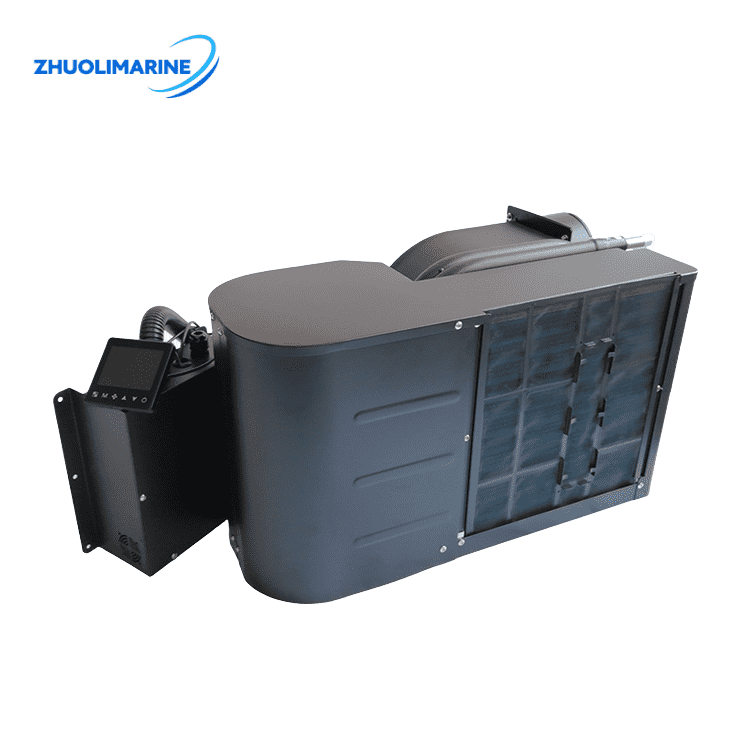
In ZhuoliMarine‘s currently listed compact DC range, the 9,000 BTU MAR-12V/09BP is rated at 660 W and 55 A, with 500 m³/h airflow and 720 L/h seawater flow. The 12,000 BTU MAR-24V/12BP is rated at 1,020 W and 42.5 A, with 600 m³/h airflow and 1,080 L/h seawater flow. Buyers should compare each model’s electrical and circulation requirements with the vessel’s available systems.
Those ratings describe different electrical systems, not interchangeable connections. A vessel wired around 12V cannot automatically use a 24V model without an appropriate power arrangement.
The published cabinet dimensions vary by model. The MAR-12V/09BP measures 480 × 330 × 335 mm, while the MAR-24V/12BP and MAR-48V/16BP each measure 590 × 345 × 345 mm. Their electrical ratings, refrigerant specifications, and cooling capacities should be reviewed individually before a model is approved for installation.
Check the Higher-Capacity Alternative and Its Consequences
Moving to a larger cooling rating does not erase the need for a suitable feeder, water supply or air outlet. A 12,000 BTU option may address a higher estimated heat gain while introducing different service demands.
The MAR-12V/12BP Yacht unit in the ZhuoliMarine range specifies 12,000 BTU cooling, 840 W rated input, 70 A rated current, 550 m³/h airflow and 1,080 L/h seawater flow. Its stated cabinet dimensions remain 480 × 330 × 335 mm.
That example shows why identical footprints can conceal materially different installation requirements. A larger unit is not automatically a better match if the cabin has limited electrical reserves or an undersized seawater circuit.
The final small boat AC review also needs to consider possible oversizing, distribution to adjoining spaces and access to the equipment after surrounding furniture is installed. Accurate sizing is a balance between calculated demand and what the vessel can support.
The cabin-load estimate establishes a provisional capacity range, while electrical, airflow and seawater specifications for ZhuoliMarine’s compact cooling and heating units define installation requirements that must be checked separately. A capacity review should compare the load range with the voltage-specific model data and identify any mismatches.
