Flexible LED displays allow businesses to move beyond conventional rectangular screens and create distinctive visual installations. From curved retail walls to immersive exhibition spaces, these displays offer new possibilities for communicating with audiences. However, choosing the right solution requires more than finding a panel that bends or a cabinet that supports curved configurations. Buyers must evaluate image quality, installation requirements, structural design, maintenance, and long-term costs before making a purchase.
- Understand the Type of Flexibility Required
Not all flexible LED display panels achieve curved shapes in the same way. Some use physically bendable modules that follow curved surfaces, while others rely on modular cabinets that connect at specified angles to create concave, convex, or polygonal configurations.
The distinction matters because the intended design determines which technology is appropriate. Cylindrical columns, flowing architectural surfaces, and complex organic shapes may require genuinely bendable modules. Curved video walls, exhibition structures, and creative commercial installations may instead work well with modular cabinets.
Before purchasing a flexible LED display, buyers should confirm the minimum bending radius, supported angles, cabinet compatibility, and installation limitations. They should also establish whether the desired shape can be achieved without compromising the screen’s alignment or structural stability.
- Choose the Right Pixel Pitch and Visual Performance
Pixel pitch measures the distance between adjacent pixels in millimeters. A smaller pixel pitch generally produces a higher pixel density, making it suitable for installations where viewers stand close to the screen. Larger pitches may be sufficient for displays viewed from farther away.
Other specifications also influence the viewing experience. Brightness should suit the ambient lighting, while refresh rate and grayscale performance can affect image presentation and smoothness. A wide viewing angle is particularly useful in retail environments, exhibition halls, and public spaces where audiences approach from different directions.
For projects that require curved layouts without physically bendable modules, Coblinks’ MC Series offers a modular alternative. It provides pixel pitches from 1.25 mm to 3.91 mm, a refresh rate of at least 3,840 Hz, and 160° horizontal and vertical viewing angles. Brightness ranges from 600 to 800 cd/m² depending on the model..
When comparing flexible LED display panels, buyers should match these specifications to viewing distance, content type, lighting conditions, and budget rather than automatically selecting the highest available resolution.
- Evaluate Cabinet Design and Installation Options
Cabinet design determines how easily a display can accommodate different layouts. Multiple cabinet dimensions can simplify the construction of screens with varied proportions, while supported rotation and curved connections can help integrators create distinctive visual arrangements.
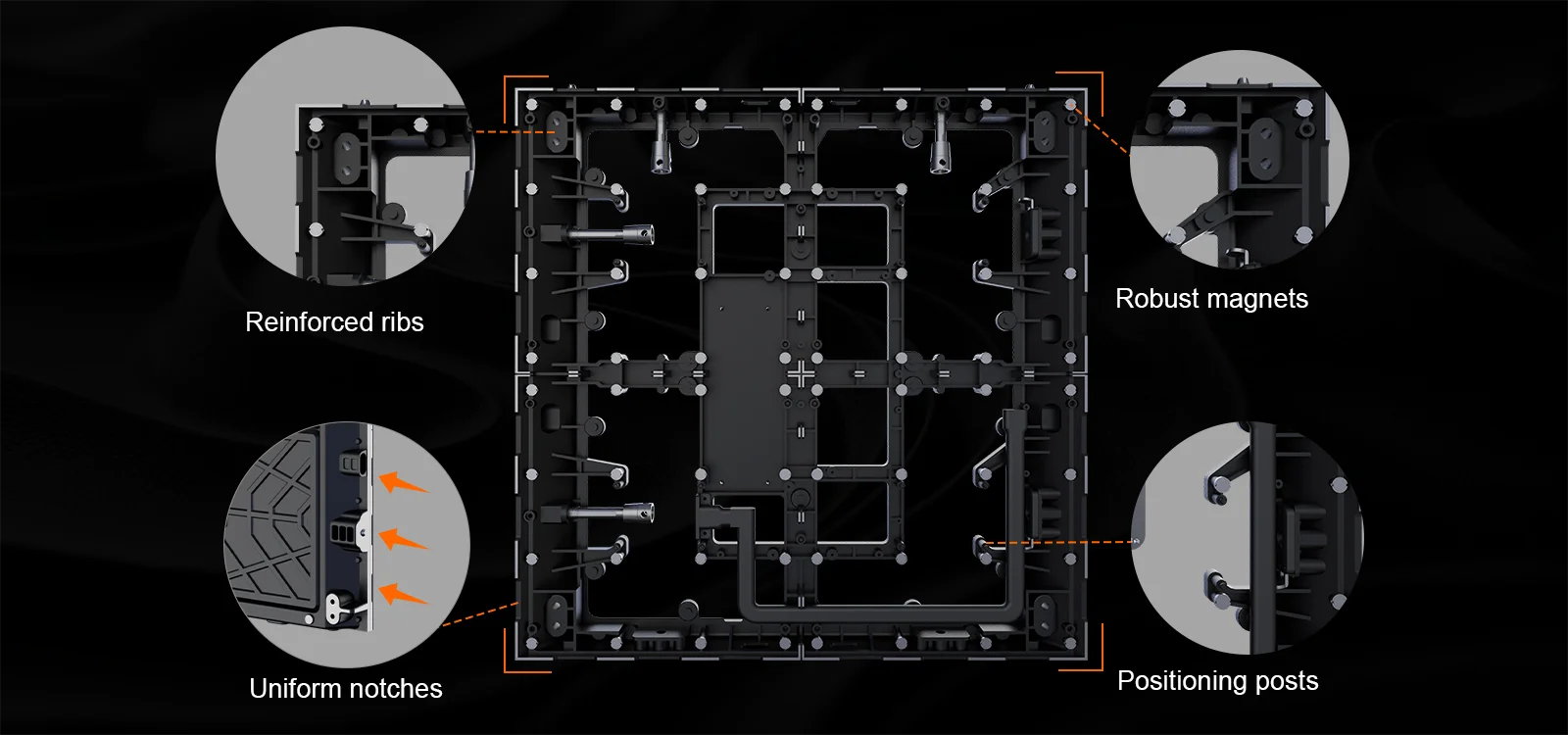
Coblinks’ MC Series features die-cast aluminum cabinets in four sizes: 500 × 1,000 mm, 500 × 500 mm, 500 × 250 mm, and 250 × 500 mm. The manufacturer specifies support for mixed cabinet configurations, concave and convex arrangements, and rotation from 0° to 90°.
These features can help project teams design curved walls, creative retail displays, and other customized indoor installations. However, buyers should confirm the permitted configuration for their specific project rather than assume that every cabinet combination supports every curve.
For a flexible LED display, installation planning should also cover mounting structures, cable routing, power distribution, screen alignment, and access for technicians. Accurate site measurements before ordering can reduce installation delays and costly modifications.
- Check Maintenance, Reliability, and Operating Costs
A visually impressive screen must also remain practical to operate. Maintenance access, component replacement, power consumption, and spare-parts availability can influence the total cost of ownership over the product’s service life.
The MC Series supports front and rear maintenance and uses screw-free magnetic modules for easier module removal. Its integrated three-in-one HUB combines the power supply, HUB, and receiving card into one unit, helping simplify the internal layout and servicing process.
Buyers should also review the manufacturer’s warranty, technical support, spare-parts policy, and stated operating conditions. For permanent installations, these details are especially important because difficult maintenance can lead to longer downtime and higher service costs.
When assessing flexible LED display panels, it is worth requesting a detailed quotation that identifies the exact model, included components, installation accessories, warranty coverage, and any additional structural requirements.
- Match the Display to the Application
The best display depends on its intended environment. Retail stores may prioritize curved product presentations and close-range image clarity. Museums and exhibition venues may need creative shapes that complement architectural features, while corporate spaces often emphasize consistent image quality and clean integration.
Coblinks is a Shenzhen-based LED display manufacturer with more than 10 years of industry experience. Its product portfolio includes commercial, rental, and creative LED display solutions for applications ranging from retail and corporate environments to events and control rooms.
The MC Series is designed for fine-pitch indoor applications and offers multiple cabinet sizes for customized layouts. Buyers considering a flexible LED display can review the official MC Series product page to assess its specifications and determine whether its modular curved configurations meet their installation requirements.
Conclusion
Purchasing flexible LED display panels requires a careful assessment of physical design, pixel pitch, visual performance, installation methods, and maintenance needs. The first step is to distinguish genuinely bendable modules from rigid cabinets designed to create curves through modular connections.
By defining the installation requirements and verifying product specifications before ordering, buyers can select a display that balances creative freedom with reliable operation. Coblinks’ MC Series provides one option for projects requiring fine-pitch indoor displays with multiple cabinet sizes and curved configuration capabilities.
